
If you’ve been in a long-term relationship, you’ve probably had this experience.
The conversation starts innocently enough. Maybe you’re discussing money, parenting, chores, sex, or whose turn it is to empty the dishwasher. Then something shifts.
Voices get louder.
Defensiveness appears.
Someone starts keeping score.
Someone else starts withdrawing.
Before long, you’re no longer discussing the issue at hand. You’re fighting for survival

What happened?
The Myth That Communication Skills Are Enough
Many couples come to therapy believing they simply need better communication skills. They’re looking for the magic sentence. The perfect script. The ideal way to phrase their complaint.
Those things can be helpful.
But they won’t save you when you’re flooded.
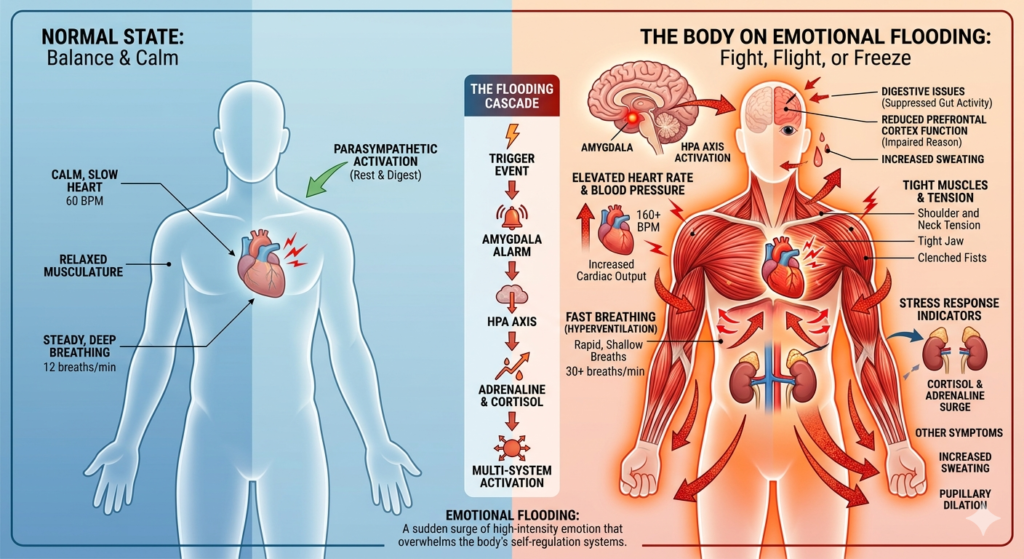
When you’re emotionally overwhelmed, your thinking brain starts going offline and your survival brain takes over. Another way of saying this is your “Wise Adult Self” goes offline and your “Adaptive Child” takes over.
In that state, you’re no longer trying to understand your partner. You’re trying to protect yourself. You may attack, defend, justify or shut down. You might become cold, sarcastic, critical, or hopeless.
The problem isn’t that you’re bad at communicating. The problem is that you’re no longer available for connection.
Flooding Is a Body Experience
Many people think arguments happen because of thoughts. Actually, arguments often happen because of something old, that gets triggers, and its held in the body. You feel your heart rate increase, muscles tense, breathing changes, stress hormones flood your system. You begin scanning for danger.
And your partner starts looking less like someone you love and more like someone who is threatening your safety, competence, worth, or autonomy.
The tragedy is that both people are usually having the same experience.
Each person feels hurt.
Each person feels misunderstood. Each person feels justified. And each person becomes increasingly incapable of hearing the other. I’ve seen couples spend thirty minutes arguing about the exact wording of a sentence when neither person can remember what the original issue was.
That’s flooding.
Why We Keep Talking When We Should Stop
Here’s one of the biggest mistakes couples make:
They believe that if they just keep talking long enough, they’ll solve the problem.
Usually the opposite happens.
When flooded, every additional sentence tends to make things worse. You become less regulated, less empathic, less curious. You become more certain you’re right, more certain your partner is wrong.
Yet many couples continue because stopping feels dangerous.
They fear:
“If I walk away, they’ll think I don’t care.”
“If we stop now, we’ll never resolve it.”
“If I don’t defend myself, they’ll believe I’m guilty.”
“If I don’t get them to understand right now, they’ll never understand.”
These fears are understandable. They’re also often inaccurate.
The reality is that a flooded conversation rarely produces understanding or repair. It usually produces collateral damage.
The Skill Most Couples Need: Calling a Time-Out
One of the healthiest relationship skills isn’t learning how to continue a fight. It’s learning how to stop one.
A Conscious “Pause” during a flooded argument is not abandonment. It’s not punishment. It’s not stonewalling.
It’s an act of relationship protection.
A healthy time-out sounds something like:
“I’m getting flooded. I’m not thinking clearly. I don’t want to say things I’ll regret. Let’s take a break and come back in an hour.”
Notice what’s happening here: You’re not blaming. You’re not diagnosing. You’re not saying:
“You’re impossible.”
“You’re too emotional.”
“You always do this.”
You’re taking responsibility for your own state – That’s maturity.

The Difference Between a Healthy Pause and Avoidance
Many people have experienced partners who disappear during conflict. There is a difference between when someone calls for a pause, and avoidance.
A healthy pause includes three things:
1. Acknowledging the flooding
2. Committing to return
3. Actually returning
The third step is crucial.
If you say you’ll come back in an hour, come back in an hour. And if you find that upon your return, you are still too flooded, agree on more time.
Trust grows when people know that difficult conversations will be resumed rather than abandoned.
What To Do During the Break
Most people misuse time-outs.
They spend the entire break mentally prosecuting their partner. They rehearse arguments. mentally collect evidence and prepare closing statements. By the time they return, they’re even more activated. That is never going to create understanding or repair.
The goal is not to prepare your next attack.
The goal is to regulate your nervous system.
Go for a walk.
Take a shower.
Breathe deeply.
Listen to music.
Stretch.
Sit quietly.
Pray or meditate if that’s meaningful to you.
Most importantly, remind yourself:
“My partner is not my enemy.”
Even if you’re hurt.
Even if you’re angry.
Even if they handled things poorly.
The relationship cannot survive if you continually cast one another as adversaries.
During the pause, ask yourself, “What is the feeling underneath my primary reaction?”
Underneath the anger is usually fear.
Underneath the criticism is longing.
Underneath the defensiveness is shame.
Most couples spend years arguing about the surface while never discussing what’s underneath. If you can come back from your pause and share the vulnerable feeling underneath, you will be sharing something more real, less threatening and the opportunity for intimacy opens
Return Different Than You Left
When you return to the conversation, don’t restart exactly where you stopped. You want to come back in a state that fosters what you want: repair. Keep in mind, that in order for repair and understanding and empathy to happen, you need to come back with greater humility, greater curiosity about the other’s experience, and greater accountability for your own thoughts, words and behaviours.
The Goal Isn't Winning
One of Terry Real’s most famous teachings is that mature love asks us to move beyond the question:
“How can I get my partner to change?”
And toward the question:
“How can I help this relationship thrive?”
Those are very different questions.
When you’re flooded, you’re focused on self-protection – When you’re regulated, you’re capable of relational wisdom. You can hold your truth without attacking, you can hear feedback without collapsing, you can stay connected while discussing difficult things.
That’s the goal. Not perfection and not never fight again.
The goal is learning to recognise when your nervous system has taken over and having the courage to pause before you cause unnecessary damage.
Every couple argues.
Healthy couples don’t avoid conflict.
They learn how to manage it. They learn that emotional flooding isn’t a sign the relationship is failing. It’s a signal to pause – regulate -reconnect.
And return to the conversation when both partners are capable of remembering something incredibly important:
Your partner is not the problem.
The pattern is.
So “pause – regulate -reconnect”, and create a new pattern